Real Talk about the Power of Saying “Yes” with Russ Wilkin, SVP of Brand and Cafes at Saxbys
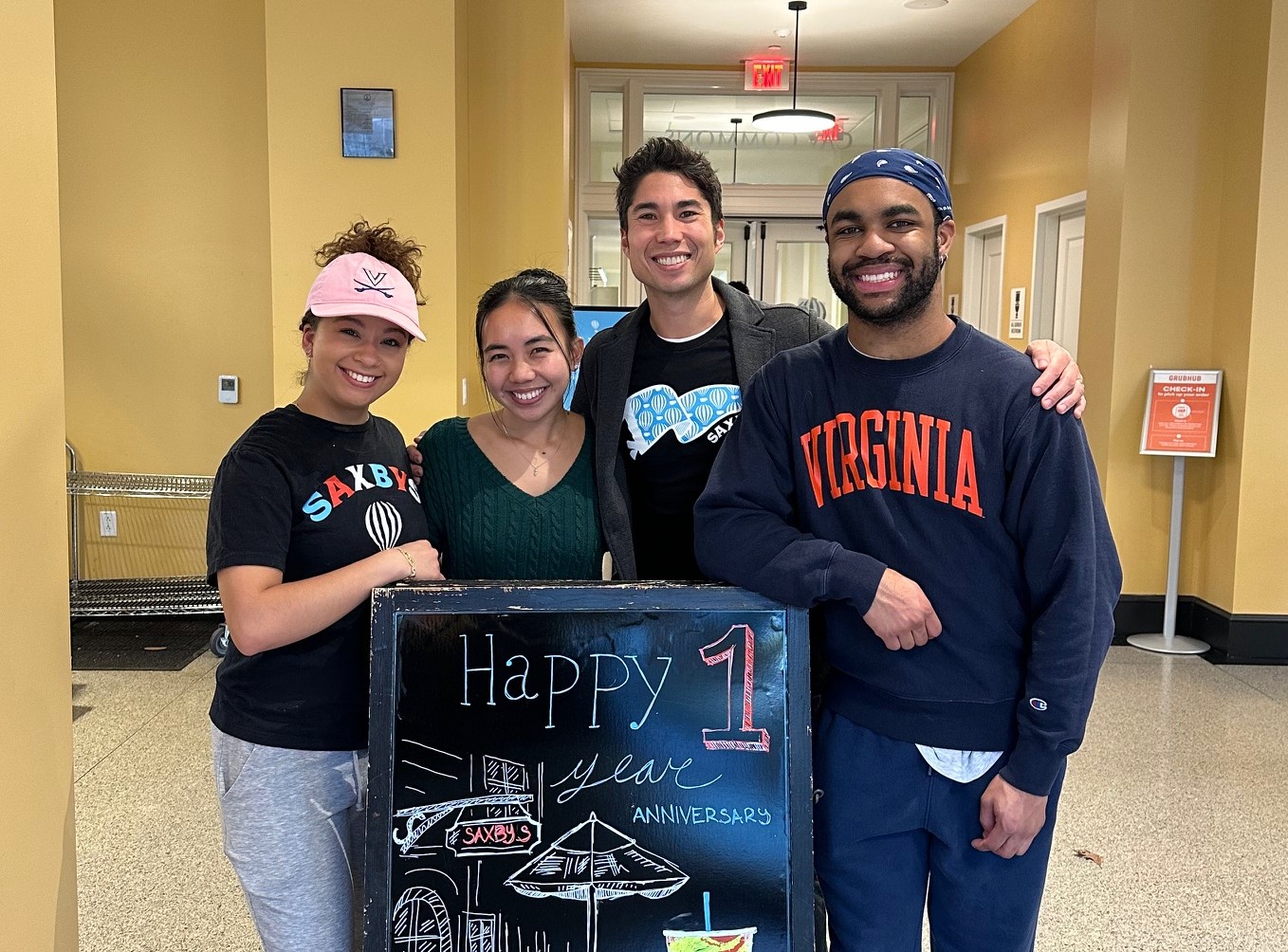
The bigger your picture, the wider your opportunities. That’s one of the takeaways from my conversation with Russ Wilkin, a dyed-in-the-wool marketer who also manages supply chain and day-to-day operations at Saxbys. I’m also impressed by the way he set his sights on career goals, then did the networking necessary to achieve them.
What’s your role at Saxbys?
I’m SVP of Brand and Cafes at Saxbys, an education company disguised as a coffee chain. We transform campus operations into credit-bearing, experiential learning opportunities for college students. We mainly operate our Experiential Learning Platform through 30 student-run cafes on college campuses across multiple states, and I manage day-to-day operations. We also have a roastery production facility in Philadelphia that I oversee.
“Brand” is in my title because I do that by trade. I joined Saxbys to build out the marketing team, but now I oversee operations mostly. I worked in marketing and products here for a couple of years, then products became supply chain, which evolved into cafe operations and, as of last year, grocery operations.
So, a big share of your job is not in marketing, is it? How did that happen?
At a previous company I worked in consumer goods – commercializing products – where supply chain played a big role. Back then, it was my least favorite part of the job, and I would almost pretend that I didn’t understand it so that I didn’t get pulled into too many supply chain projects. In fact, day-to-day operations was not in my job description at all. I guess I ended up doing it because it’s in my makeup to say “yes” to helping solve a problem when it arises.
Then, here at Saxbys, I saw myself as a brand person and was establishing myself as one, still trying to push away from operations. But a couple of years ago, our CEO approached me and said, “I know that you look at yourself as a brand person, but we could really benefit from your help in operations.”
How did you turn the corner on that? And how do you make your marketing and non-marketing responsibilities work together?
At first I hesitated to take the CEO’s suggestion. But then I thought about the upside.
Saxbys is not a small company, but we’re not in the Fortune 500, either. One of the big advantages of working for a company like ours is that you can make a big impact in whichever department or team you’re working in. I realized that the impact I could make needn’t be isolated to marketing. So when I had the opportunity to help with operations, I knew it wasn’t a side project, but an extremely meaningful part of the business. I think my work in operations and some of the processes I’ve helped put into place have helped get us to where we are now, where cafes are twice as profitable as they were a couple of years ago.
“I’ve learned more in the past two years than in the previous 12 years by just saying ‘yes’ to opportunities.”
Mind you, by the time I started at Saxbys, marketing felt very natural to me and I felt confident I could do it. Everything I’ve done since then has not felt as natural, but I’ve packed a lot of experience in operations and production into a relatively short time.
And the value-add is reciprocal. The people on my team are much more knowledgeable than I am in a variety of subject matters, so my role isn’t to direct each department; instead, I try to help them overcome obstacles. They, in turn, train me on how to run supply chain, how to develop product and other things that don’t come as naturally to me.
I love that concept of saying “yes.” Do you apply it outside of work?
I do. I say “yes” to things that are aligned with my values and passions, like my family. And learning, also. For example, I was asked recently whether I would moderate a panel. I could have said “yes” to that simply for the opportunity to meet people. But I could say “yes” to that and get even more out of it by going a few hours early and learning something new by attending the keynote and panels. When I thought of it that way, saying “yes” was easy because it enabled me to listen to a strong roster of execs and CEOs all day.
It’s funny – I also say “no” to a lot of things that I believe would be distracting so that I can say “yes” to things that I think would make an impact. I try to train my team to see that it’s okay to say “no” so you can say “yes” to something else, provided you’re very clear on what you’re saying “yes” to. Knowing what to say “yes” to is valuable in knowing what to say “no” to.
Talk about your career path. How have you built the connections that enabled you to get where you are today?
Honestly, in some ways it seems like misdirection.
First of all, in college I had been most passionate about marketing and had done an internship in advertising. But I graduated during the Great Recession, and it was hard to find work in marketing and advertising, so I took a job as a product manager for a relatively small software company. I really did enjoy the work, but after a couple of years, I knew that I wanted to be a marketer in my career. I don’t know why I thought it was a good idea to leave software in 2009, but I did. I went back to school – University of Maryland – full time to get my MBA, with the concrete goal of becoming a brand manager.
During orientation at business school, an executive from the Campbell Soup Company presented. Now, Campbell’s had been a big part of my home life growing up. My dad, my uncle and a couple of my cousins had worked at Pepperidge Farm – a subsidiary of Campbell’s. My mom immigrated to the U.S. in her thirties, and the Campbell’s Great American Cookbook was the first and most important book she used to learn how to cook “American” food. We were very much a Campbell’s family and we always had their products.
So, immediately after seeing the presentation, I told myself, “Not only am I going to be a brand manager, but I’m also going to be a brand manager at the Campbell Soup Company.” Throughout my MBA program, I found every alumnus who had interned or worked at Campbell’s and I got advice from them on how to get in there. I even did a couple of mock interviews. First I landed an internship at Campbell’s, then a full-time job after graduation.
That’s how I got into marketing. At Campbell’s I had multiple brand-management roles and got exactly what I wanted out of them: I learned to be a marketer. Beyond the job itself and the company’s training in brand management, I absorbed all the experience of my peers and the execs at Campbell’s, just by being in the room with them. I looked at it as Marketing 201, like six years of training from just watching other people do what they do.
Once you’d decided that you were going to build and use your network to find a way into Campbell’s, was it scary reaching out?
Yes – until I got to the first “yes.”
Sure, it was scary to go out and start asking for help. But then I got my first “I’d be happy to give you 30 minutes of my time and experience, and tell you how to position yourself for a role here.” That led to an introduction to someone else, then to someone else, and so on. It was an important exercise in building up my confidence and in learning how to ask for help, advice and connection.
It’s all about connection.
The story of Russ’s winding career path made for a good interview. So did his perspective on the dividends of saying “yes” to the opportunities that have arisen on that path. Find out more about Russ Wilkin from his LinkedIn profile.